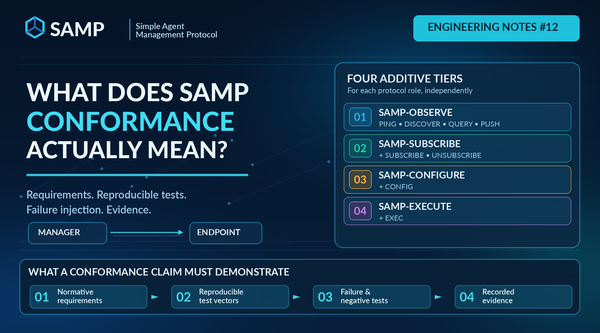
SAMP Engineering Notes #12
What does SAMP conformance actually mean? Explore role-specific tiers, mandatory requirements, reproducible test matrices, failure injection, and evidence-based interoperability claims.
What does SAMP conformance actually mean? Explore role-specific tiers, mandatory requirements, reproducible test matrices, failure injection, and evidence-based interoperability claims.
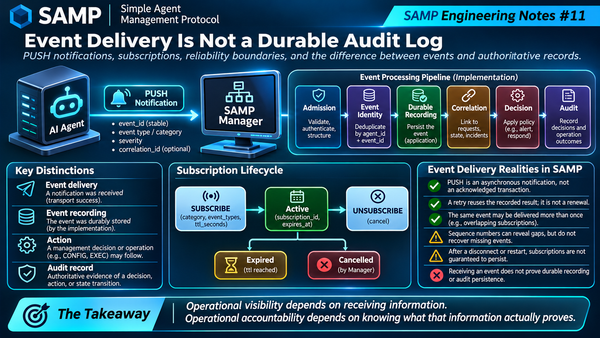
Receiving an event is not the same as recording it. Explore SAMP PUSH notifications, subscription ownership, duplicate delivery, recovery limits, and the boundary between events and durable audit records.
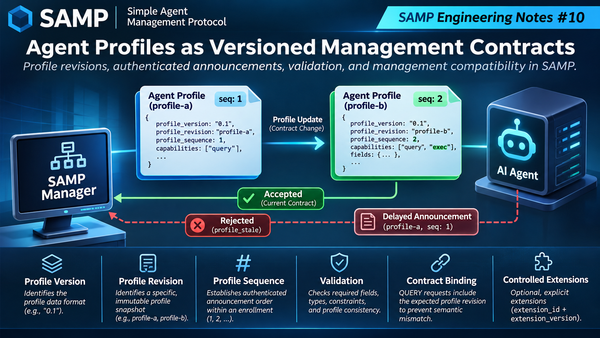
How SAMP treats agent profiles as versioned management contracts, with authenticated announcements, schema validation, revision-bound queries, and safe recovery without confusing capabilities with authority.
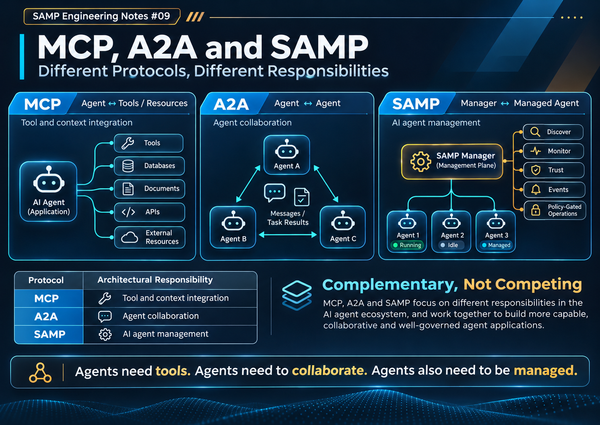
MCP, A2A and SAMP address different responsibilities in AI systems. Explore the distinction between tool integration, agent collaboration, and AI agent management.
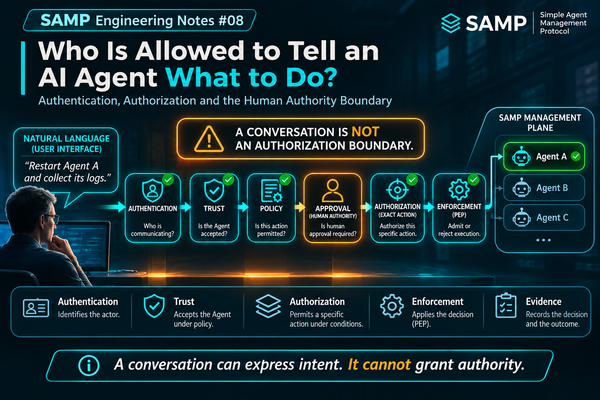
Understanding an instruction is not the same as being authorized to execute it. Explore how SAMP separates authentication, trust, exact-action authorization, human authority, and policy enforcement.
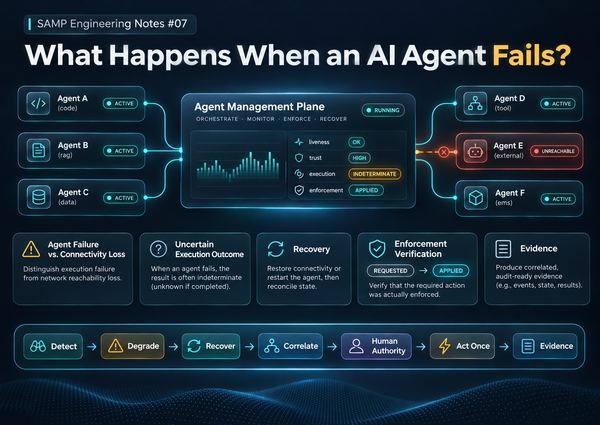
What happens when an AI agent crashes, becomes unreachable, or leaves an operation's outcome uncertain? Explore SAMP failure management, recovery, trust, enforcement, and lessons from AgMS Alpha.
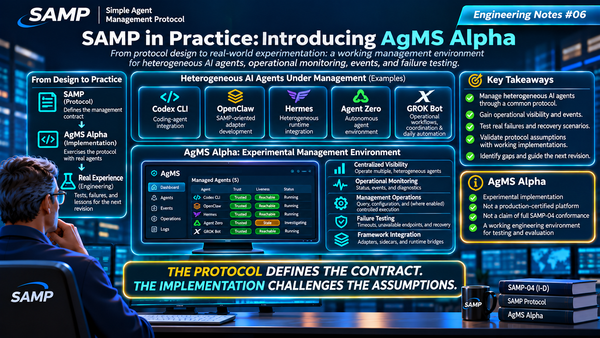
From protocol design to real-world experimentation. Discover how AgMS Alpha applies SAMP management concepts to heterogeneous AI agents, monitoring, operational events, and failure testing.
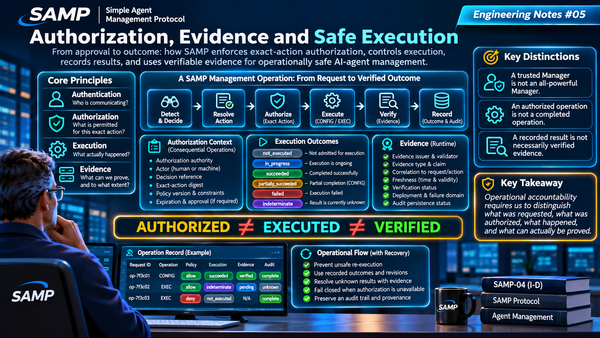
An authorized AI-agent operation is not necessarily executed, and execution is not necessarily verified. Explore how SAMP combines exact-action authorization, runtime evidence, recorded outcomes, and safe recovery.
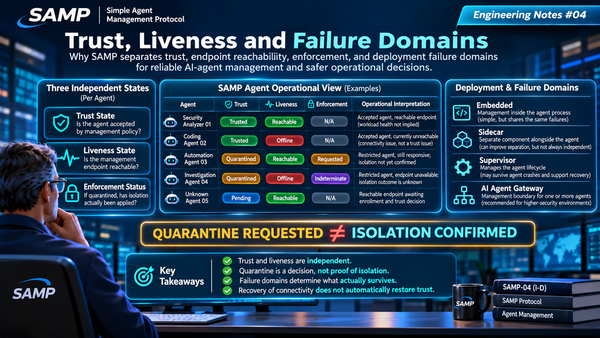
An AI agent can be reachable but untrusted, trusted but offline, or quarantined without being isolated. Explore how SAMP separates trust, liveness, enforcement, and failure domains.
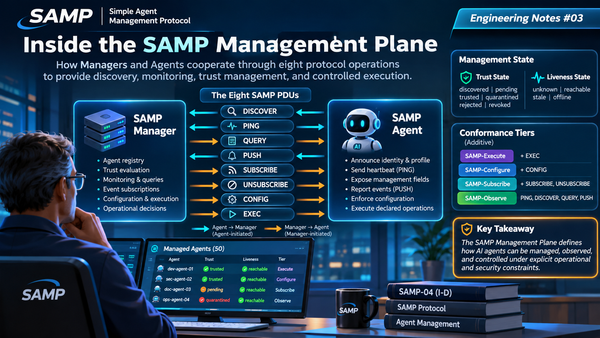
Inside the SAMP Management Plane: how Managers and Agents cooperate through eight protocol operations to provide discovery, monitoring, trust management, controlled execution, and operational accountability.
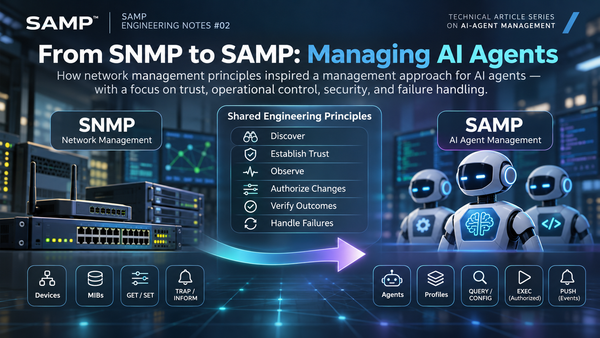
From managing routers and switches to managing AI agents. Discover how decades of network management experience inspired SAMP's approach to monitoring, trust, authorization, operational control, and failure handling.
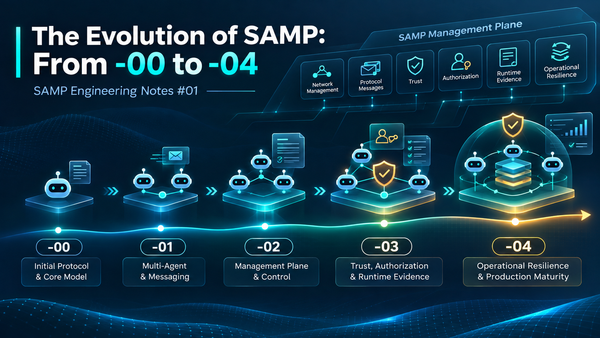
From the first Internet-Draft to SAMP v0.2: five revisions exploring AI agent management, trust, authorization, runtime evidence, and operational resilience.

News
Introducing the Simple Agent Management Protocol (SAMP), an experimental, vendor-neutral management plane for heterogeneous AI agents, covering discovery, monitoring, security, and operational control.