SAMP Engineering Notes #09
MCP, A2A and SAMP address different responsibilities in AI systems. Explore the distinction between tool integration, agent collaboration, and AI agent management.

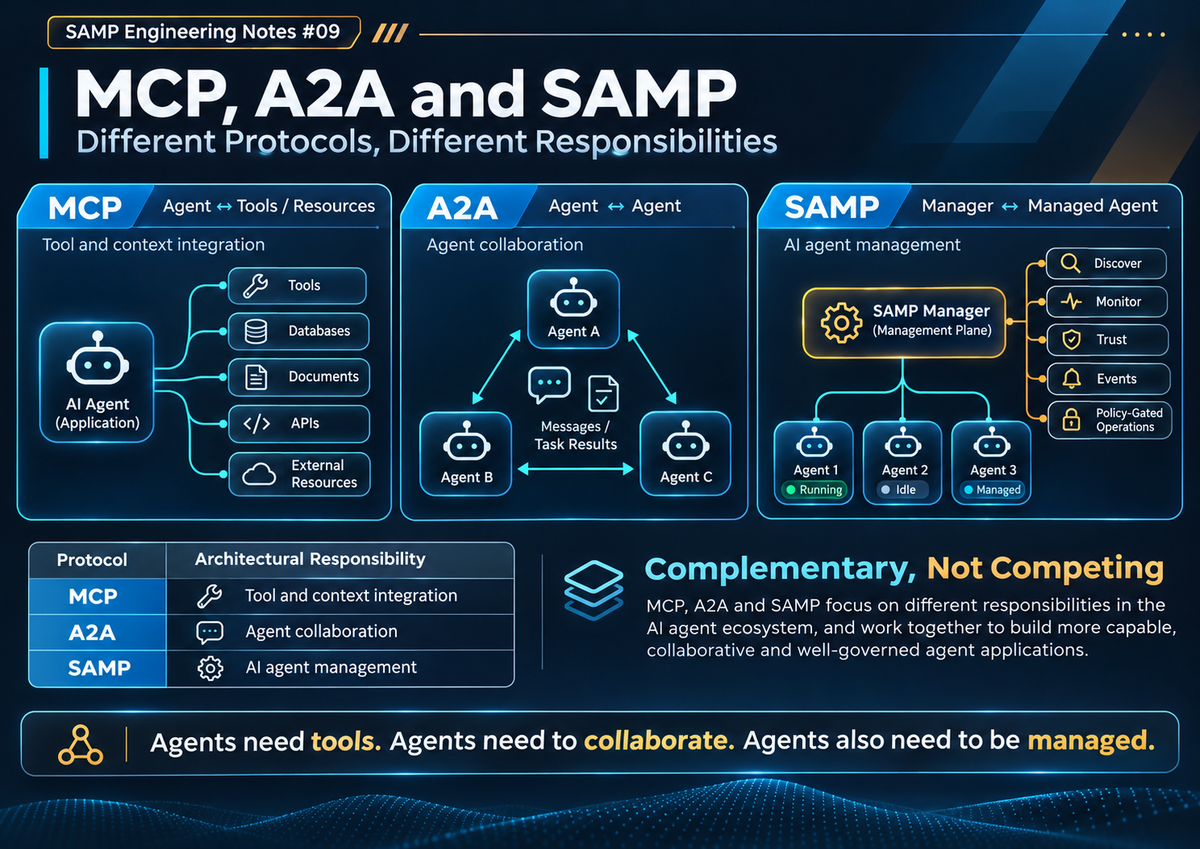
MCP, A2A and SAMP: Different Protocols, Different Responsibilities.
Agents need tools. Agents need to collaborate. But agents also need to be managed.
As AI agent ecosystems evolve, several protocols have emerged to address different aspects of agent interoperability.
Among them, the Model Context Protocol (MCP) and Agent2Agent Protocol (A2A) have attracted considerable attention.
Both address important interoperability problems.
However, connecting an AI agent to external tools and enabling collaboration between agents are not the same as managing those agents as operational infrastructure.
This distinction is central to the Simple Agent Management Protocol (SAMP).
The objective is not to replace existing protocols.
It is to address a different responsibility.
1. Three Different Questions
Consider three questions that arise when operating an AI agent environment.
How does an agent interact with external tools and information?
MCP provides standardized interfaces through which AI applications can discover and use tools, resources, and related capabilities.
How does one agent collaborate with another?
A2A provides an interaction model through which independent agents can discover capabilities, exchange messages, manage tasks, and exchange results.
How does an operator manage the agents themselves?
SAMP proposes a management-plane interface for discovering, enrolling, monitoring, and managing heterogeneous AI agents under explicit operational and security policies.
These responsibilities can coexist within the same environment.
| Protocol | Primary responsibility | Typical interaction |
|---|---|---|
| MCP | Tool and context integration | AI application ↔ External capabilities |
| A2A | Agent collaboration | Agent ↔ Agent |
| SAMP | AI agent management | Manager ↔ Managed Agent |
This comparison describes their primary architectural roles, not an exhaustive list of capabilities.
MCP and A2A also provide security, lifecycle, and operational mechanisms within their respective scopes.
The distinction is therefore not that those protocols lack operational features.
It is that the managed object and the responsibility of the protocol are different.
2. Using a Tool Is Not Managing an Agent
Imagine a coding agent working on a software repository.
Through MCP, it may access a version-control service, query a database, retrieve documentation, or invoke an external tool.
These operations support the Agent's assigned workload.
But the infrastructure operator may have other questions:
- Is the coding agent currently reachable?
- Which runtime and version is deployed?
- Has its management profile changed?
- Is it trusted under the current management policy?
- Has it reported an operational fault?
- Can a management operation be safely authorized?
- What evidence supports the reported state?
These questions concern the managed Agent rather than its application-level tool interactions.
An MCP integration can expose custom tools that answer some of them. Organizations can build monitoring and management services using MCP-accessible tools.
However, such an implementation does not automatically establish a shared management protocol with defined enrollment, trust ownership, state semantics, and policy-gated management execution.
SAMP addresses these responsibilities explicitly.
Tool accessibility does not automatically establish management authority.
3. Collaboration Is Not Operational Supervision
Now consider two agents working together.
Agent A is investigating a security incident.
Agent B specializes in infrastructure diagnostics.
Using an agent communication protocol such as A2A, Agent A may request assistance from Agent B.
The agents can exchange information, track a collaborative task, and communicate its outcome.
But what happens if Agent B's runtime becomes unreachable?
The collaborative task may fail, remain incomplete, or require reconciliation.
A2A provides task lifecycle and status mechanisms relevant to the collaboration.
The infrastructure operator, however, may need to determine something different:
Is Agent B's runtime still operational?
Has its management endpoint stopped responding?
Has its trust disposition changed?
Is an independent management component available to investigate or recover it?
Does a restart require additional authorization?
Those are management-plane questions.
SAMP does not replace A2A's task model.
Nor does an A2A task status automatically determine the SAMP trust or liveness state of the underlying managed Agent.
A task can fail while its Agent remains healthy.
An Agent can become unreachable while the outcome of a previously initiated task remains uncertain.
The state of a task and the state of the Agent executing it are not interchangeable.
4. Discovery Means Different Things
All three protocols involve forms of discovery, but they do not necessarily discover the same thing.
In MCP, an application can discover capabilities such as exposed tools and resources.
In A2A, an Agent Card describes an agent's capabilities, skills, supported interfaces, and interaction requirements.
In SAMP, the DISCOVER operation is an Agent-to-Manager announcement associated with the management profile and enrollment process.
A SAMP Profile declares management-relevant information such as identity, exposed fields, capabilities, and operational policies.
The Manager evaluates the announcement within its management and trust model.
Discovery in one protocol does not automatically constitute enrollment or authorization in another.
A system may know how to communicate with an agent without having admitted it as a trusted managed entity.
Likewise, knowledge that a tool exists does not authorize every possible use of that tool.
The architecture needs to preserve these boundaries.
5. A Practical Combined Architecture
Consider a hypothetical infrastructure environment containing several heterogeneous AI agents.
One agent performs incident analysis.
Another performs coding and automation.
A third provides infrastructure diagnostics.
Each may use different runtimes, models, and frameworks.
A combined architecture could operate as follows.
MCP provides access to tools and information.
The agents interact with databases, repositories, monitoring services, and other supported systems.
A2A supports collaboration between agents.
An incident-analysis agent delegates a diagnostic task to another agent and receives its results.
SAMP provides an operational management interface.
A SAMP Manager maintains management records, evaluates reachability and trust, processes operational events, and initiates explicitly permitted management operations.
These interactions do not need to pass through one another.
The tool, collaboration, and management paths can operate independently while being correlated by an external application.
This matters when something fails.
A failed tool call may be visible through MCP.
A failed collaborative task may be visible through A2A.
A SAMP Manager may independently observe that the Agent's management endpoint is reachable, stale, or offline.
An operations platform can correlate these observations without pretending they represent the same state.
Importantly, this correlation does not occur automatically merely because all three protocols are present.
It requires integration design, appropriate identifiers, and operational evidence.
6. Management Needs Its Own Authority Boundary
SAMP -04 also addresses an important question: who is permitted to perform consequential management operations?
A management system might need to modify an Agent's exposed configuration or invoke an explicitly declared management command.
Such operations must respect the Agent's management profile, applicable policy, and required authorization.
For consequential CONFIG and EXEC operations, SAMP defines an authorization context bound to the exact action.
The final enforcement boundary must validate the authorization before admitting execution.
This does not imply that MCP or A2A lack authentication or authorization mechanisms.
Both have their own security requirements and interaction models.
The distinction is that SAMP specifies authorization in the context of management operations on managed AI agents.
A successful application-level interaction cannot silently grant additional management authority.
7. Independence Matters During Failure
One particularly important consideration is the placement of the management endpoint.
A SAMP interface embedded inside an Agent may become unavailable when the Agent crashes.
A sidecar, supervisor, gateway, or infrastructure-level management component may provide different failure and recovery characteristics.
However, placement alone is insufficient proof of independence.
A sidecar running on the same host may share critical dependencies with the Agent it manages.
SAMP therefore distinguishes deployment topology from actual failure-domain independence.
The Manager must not assume that a reachable endpoint can independently control a failed or compromised Agent merely because it is labeled a gateway or sidecar.
This is an operational management concern that becomes especially important when agents perform consequential actions.
A management interface is most valuable when its guarantees remain meaningful under failure.
8. SAMP Is Not Trying to Become Everything
A useful protocol needs clear boundaries.
SAMP does not define how AI agents reason.
It does not specify an agent collaboration language or replace A2A task exchanges.
It does not define how agents invoke external tools or replace MCP.
It does not replace organizational identity systems, policy engines, or observability platforms.
And it does not prescribe which AI framework, model provider, or orchestration platform an organization must use.
Its objective is narrower:
To provide a consistent management-plane contract for heterogeneous AI agents.
That includes declared management capabilities, operational state, trust and enrollment semantics, management requests, events, and policy-controlled operations.
The current SAMP Internet-Draft is experimental. Interoperability and operational guarantees must be established by implementations and testing, not assumed from the existence of a specification.
9. Different Responsibilities, Shared Infrastructure
As agent deployments grow, interoperability becomes more than a question of whether two components can exchange messages.
Operators also need consistent ways to observe, supervise, and control the systems executing those messages.
MCP helps connect AI applications to tools and information.
A2A helps independent agents collaborate.
SAMP addresses the operational management of the agents themselves.
The technologies may overlap in implementation details, and future integrations may reuse existing transport or discovery mechanisms.
But the underlying responsibilities remain distinct.
There is no need for a protocol rivalry.
There is a need for clear architectural boundaries.
An agent ecosystem should support communication, collaboration, and management without confusing one for another.
That is the role SAMP proposes to fill.
About SAMP: The Simple Agent Management Protocol is an experimental, vendor-neutral management-plane proposal for heterogeneous AI agents.
References