SAMP Engineering Notes #01
Introducing the Simple Agent Management Protocol (SAMP), an experimental, vendor-neutral management plane for heterogeneous AI agents, covering discovery, monitoring, security, and operational control.


Ιntroducing the Simple Agent Management Protocol
Originally published: 18 August 2026
Updated: 4 November 2026 to reflect SAMP version 0.2 and Internet-Draft revision -04.
AI agents are becoming operational systems. They discover resources, invoke tools, exchange tasks, retain memory, and increasingly act with varying degrees of autonomy.
But as agent environments grow, a fundamental operational question remains:
How do we consistently discover, monitor, configure, secure, and govern heterogeneous AI agents across different frameworks, vendors, and deployment environments?
The Simple Agent Management Protocol (SAMP) is an experimental, vendor-neutral protocol proposal addressing this challenge.
An Operational Management Plane for AI Agents
SAMP defines a lightweight management-plane protocol between a management system and managed AI agents.
Its purpose is not to define how agents reason, collaborate, select tools, or perform tasks.
Its purpose is to provide the operational mechanisms required to observe, manage, and control heterogeneous agent environments.
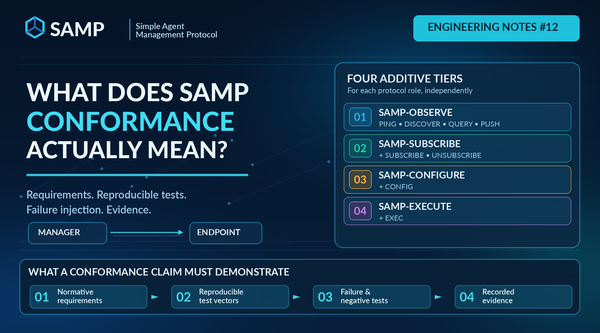
SAMP version 0.2 defines eight core protocol operations:
- DISCOVER: Agent discovery, identity, and enrollment information.
- PING: Agent-initiated heartbeat and endpoint reachability.
- QUERY: Structured retrieval of declared agent information and operational state.
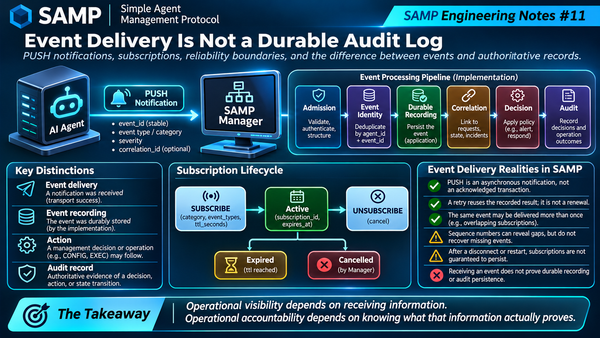
- PUSH: Asynchronous operational event delivery.
- SUBSCRIBE: Establishment of time-bounded event subscriptions.
- UNSUBSCRIBE: Termination of existing event subscriptions.
- CONFIG: Controlled modification of explicitly declared configuration fields.
- EXEC: Policy-gated execution of explicitly exposed operations.
Beyond these operations, SAMP defines management concepts including:
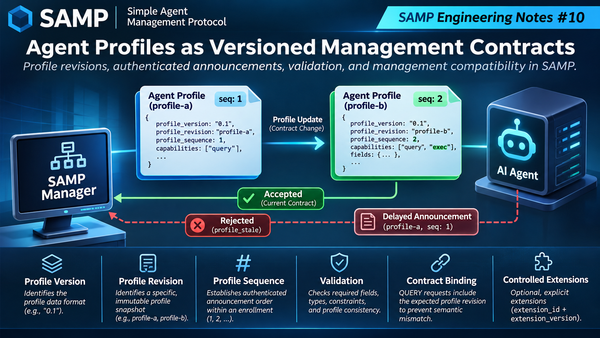
- Agent identity, profiles, and capability declarations.
- Explicit enrollment and trust-state management.
- Independent trust and liveness states.
- Authentication, replay protection, and message integrity.
- Authorization bound to consequential management operations.
- Runtime evidence and operational accountability.
- Failure-aware execution outcomes and recovery safeguards.
- Endpoint deployment models and enforcement boundaries.
SAMP approaches AI agents as managed operational entities, not merely as autonomous software components.
Complementary, Not Competitive
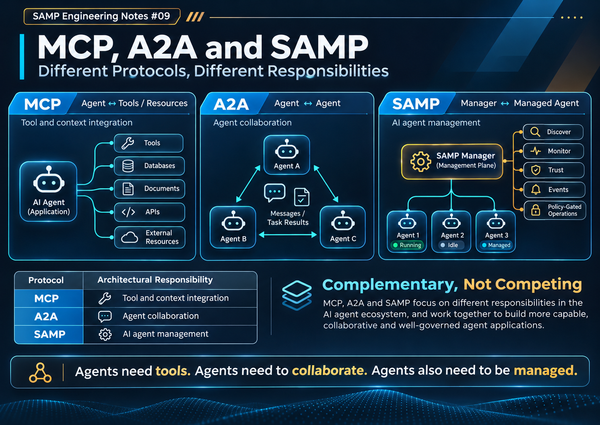
The emerging AI-agent ecosystem contains several distinct protocol relationships.
Agent-to-agent protocols such as A2A address communication, collaboration, delegation, and task exchange.
MCP addresses standardized access to tools, resources, and context.
OpenTelemetry provides observability through traces, metrics, and logs.
OpAMP addresses operational management of telemetry and data-collection agents.
SAMP focuses on the operational management of heterogeneous AI agents, including enrollment, trust decisions, controlled configuration, consequential execution, and management enforcement.
These technologies have different responsibilities and may coexist within the same environment.
SAMP draws inspiration from established network-management engineering, particularly SNMP, while introducing management semantics specific to AI-agent environments.
The intention is not to duplicate existing protocols unnecessarily, but to identify and experimentally validate management requirements that existing mechanisms may not fully address.
Experimental by Design
The first SAMP Internet-Draft was published on 17 August 2026.
Since then, the specification has evolved through successive revisions incorporating architectural refinements, security requirements, authorization mechanisms, operational evidence, and failure-recovery semantics.
The current specification is:
SAMP version 0.2
draft-efstathiou-samp-agent-management-04
Published: 26 October 2026
Intended status: Experimental
Read the current SAMP Internet-Draft
SAMP remains an individual Internet-Draft. It has not been adopted by an IETF Working Group and is not endorsed by the IETF.
Its purpose is to establish a concrete protocol baseline that can be reviewed, challenged, implemented, and tested.
Experimental does not mean that operational safety is optional.
It means that the design, assumptions, implementation behavior, and interoperability requirements must be evaluated through engineering evidence.
From Specification to Implementation
SAMP is not limited to theoretical protocol design.
The Agent Management System (AgMS) is an experimental software implementation developed to evaluate SAMP management concepts across heterogeneous AI-agent environments.
Currently in Alpha development, AgMS provides practical experience with agent integration, operational monitoring, management workflows, security controls, event handling, and controlled failure scenarios.
This work helps identify implementation challenges and potential protocol improvements.
AgMS is not presented as a production-certified system or an independently validated, fully conformant SAMP 0.2 implementation.
What Comes Next
The project continues to focus on:
- Independent technical review and protocol refinement.
- Security analysis and authorization boundaries.
- Experimental Manager and Agent implementations.
- Framework adapters and heterogeneous runtime integration.
- Positive and negative protocol testing.
- Failure injection and recovery analysis.
- Interoperability with independently developed implementations.
- Optional integration with complementary verification and authorization mechanisms.
The objective is not simply to publish another protocol specification.
It is to determine whether a consistent, secure, and interoperable management plane can be established for heterogeneous AI agents.
Engineers, protocol designers, agent-framework developers, security researchers, and infrastructure operators are invited to examine the specification, challenge its assumptions, and contribute implementation experience.
Technical criticism is not merely welcome.
It is necessary.
Technical contact: [email protected]